The Watch Case Building: How a Clock Tower Shaped Riverside
The story of the Philadelphia Watch Case Company, the factory that made Riverside the watch case capital of the world, and the clock tower still standing on Pavilion Avenue.
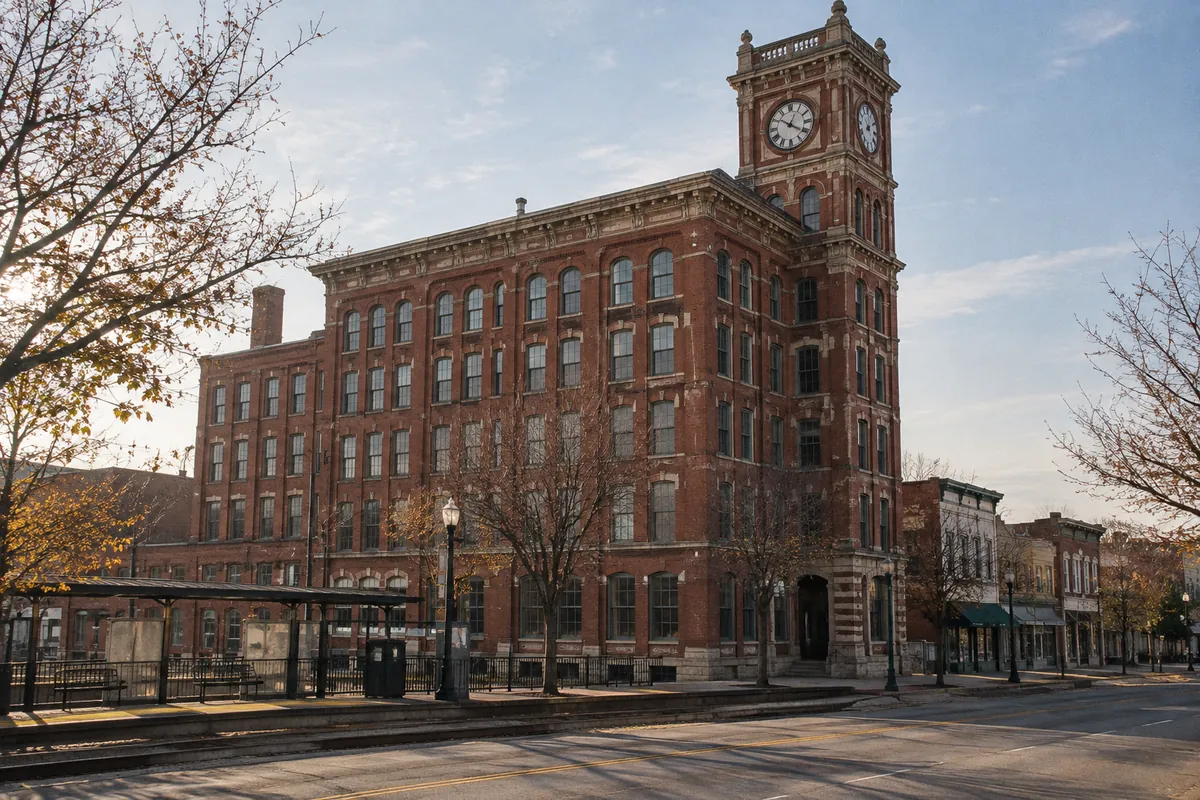
Drive into Riverside from almost any direction and you see it before you see anything else: seven stories of brick, a clock tower on top, sitting at the corner of Pavilion Avenue and Zurbrugg Way. Locals call it the Watch Case. For about fifty years it was the reason this town existed.
The building began as a hotel. Samuel Bechtold, who laid out the town in 1851 when it was still called Progress, ran the Pavilion Hotel on that corner. In 1892 Theophilus Zurbrugg bought it, expanded it, and converted it into a factory for his Philadelphia Watch Case Company. The finished plant opened around 1908.
What they actually made
Watch cases. Not the movement, not the hands, not the glass. The metal housing that held a pocket watch, in gold and in base metal, engraved and finished to a standard that let the company sell around the world. At its peak the Riverside plant employed more than a thousand people and was described as the largest watch case manufacturer anywhere.
That mattered to the shape of the town, not just its payroll. Zurbrugg had rowhomes built for workers within walking distance of the plant. The blocks around downtown still carry that housing, which is why Riverside has so many twins and rowhomes and so few large lots. He also left $250,000 in his will for a hospital two blocks away, built for the health of the people who worked for him.
The long decline
Zurbrugg died in 1912. Pocket watches gave way to wristwatches, and the case business went with them. The factory closed in the mid 1950s. An offshoot, Riverside Metals, kept going into the early 1970s. By 1977 the complex was being stripped and vandalized, and the following year it was listed on the National Register of Historic Places, which protected the shell but not the future.
Since then it has been the town's most argued about building. Engineering firms and the historical society used office space in the tower at various points. Developers came and went. A 2021 redevelopment plan proposed converting the factory and office tower to apartments, and a plan from an earlier owner called for 64 units. As of 2026 the building is still vacant, still structurally sound, and still the thing everyone has an opinion about.
Why it still matters
Three reasons. The first is that the building is the town's skyline. Without it, Riverside looks like every other river town in Burlington County.
The second is that the factory explains the housing stock. If you are shopping in Riverside and wondering why the houses are older, smaller and closer together than in Delran or Cinnaminson, this is the answer. The town was built to put workers within walking distance of a plant, not to sell quarter acre lots.
The third is that redevelopment, whenever it happens, will change the downtown. A vacant landmark does nothing for the blocks around it. Apartments in that building would put people on Pavilion Avenue in the evening, which is the difference between a downtown and a row of storefronts.
If you want the rest of it, the Riverside Historical Society is in the former 1930s train station at 3 Franklin Street, open Thursdays 9 to 4 and the second and last Saturday of the month from 1 to 4. Admission is free. The exhibits on the factory and Zurbrugg Hospital are worth the trip, and the volunteers know more than any website does.
Questions about your own street?
Send me the address and I will pull the comps, the flood map and the last five sales on the block. No cost, no pitch.